-
FunnlQ
- August 28, 2026
The demo always looks perfect. The renewal conversation a year later rarely does.
A founder we spoke with recently replaced two human SDRs with an AI SDR platform in the same month. The pitch was hard to argue with on paper: an AI seat that never calls in sick, never asks for a raise, and can run outreach at a volume no human rep could match.
The first month looked like a win. Outbound volume jumped roughly sixfold. The activity dashboard was the busiest it had ever been.
Three months in, the picture was murkier. Meetings were getting booked, but a noticeably smaller share of them turned into real opportunities than the team was used to. Reply rates, measured as a percentage of the much larger volume, had actually fallen. The founder wasn’t sure anymore whether the AI SDR was working or just working differently, in a way that was harder to evaluate.
This isn’t a story about AI SDRs failing, and it isn’t a story about them being the obvious future either. It’s a story about a question most companies are answering with a demo instead of data: where does an AI SDR actually help, and where does it quietly create a different problem than the one it was bought to solve?
This is the newest piece in our outbound series, and it’s the one we get asked about most right now. Everything else in this series — ICP, infrastructure, deliverability, authentication, the in-house vs. outsourced decision — still applies whether a human or an AI is executing the outreach. This piece is about the decision layered on top of all of it: who, or what, should actually be doing the sending.
Why It Matters
The adoption numbers alone explain why this question can’t be ignored anymore. Autobound’s 2026 State of AI Sales Prospecting report puts the share of B2B sales teams using AI in some capacity at 81% as of 2026, up from roughly 50% in 2024 — a fast shift, not a slow creep. Gartner has gone further, predicting that by 2028, AI agents will outnumber human sellers by 10 to 1 — though Gartner pairs that prediction with an important caution worth taking seriously: fewer than 40% of sellers are expected to report that AI agents actually improved their productivity. Read together, those two data points aren’t really an adoption story. They’re a warning about deploying AI without the right foundation underneath it, which is exactly the theme of this piece.
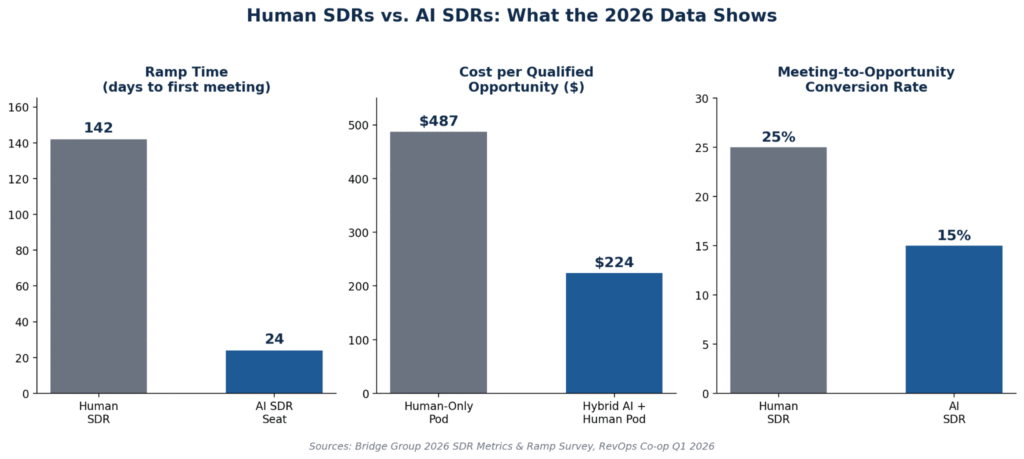
The economics are genuinely compelling on the surface. Reported cost-per-lead figures, cited from MarketsandMarkets’ analysis, put AI SDR platforms at roughly $39 per lead, compared to roughly $262 for a human SDR — an 85% reduction, if the comparison is taken at face value. Ramp time tells a similarly dramatic story: aggregated 2026 benchmarking citing Bridge Group’s ramp research found AI SDR seats reaching first-meeting productivity in a mean of 24 days, against 142 days for a new human hire — worth noting that 142 days sits toward the higher end of commonly cited human SDR ramp benchmarks, which more often cluster around 3-4 months depending on deal complexity. Set those two numbers side by side and the appeal is obvious.
The reason this matters more than a simple cost comparison, though, is what happens after that first meeting gets booked — which is exactly where the founder in the story above started noticing the picture wasn’t as clean as the initial numbers suggested.
The Framework: It’s Not AI vs. Human — It’s Where Each One Wins
The mistake most companies make isn’t choosing AI or choosing humans. It’s treating the decision as all-or-nothing, when the data increasingly points to a specific division of labor across the outbound workflow, not a wholesale replacement.
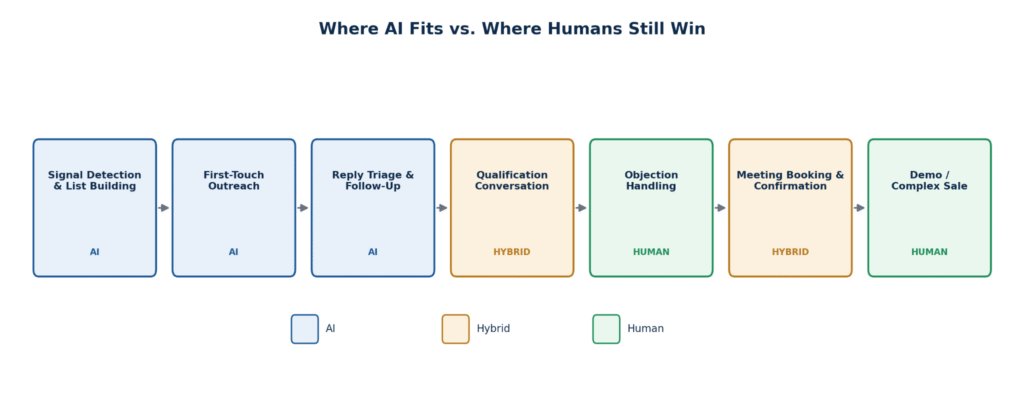
Where AI consistently wins: signal detection and list building, first-touch outreach at volume, and reply triage and follow-up sequencing. These are pattern-matching, high-volume, low-ambiguity tasks — exactly the kind of work that consumes the bulk of a human SDR’s time without using much of their actual judgment. Research from Salesforce’s State of Sales work found human SDRs spending only 28-30% of their time on genuinely revenue-generating activity, with roughly 41% of the workday absorbed by administrative tasks. AI eating that administrative layer isn’t a controversial idea — it’s arguably the least controversial part of this entire shift.
Where humans still consistently win: objection handling and complex, multi-stakeholder deals. This is where the RevOps Co-op’s Q1 2026 survey of 412 stalled or cancelled AI SDR deployments becomes genuinely instructive — the most common failure modes weren’t technical glitches. They were high persona-variance ICPs (accounts where the buyer and their concerns vary too much for a scripted or even adaptive AI flow to handle well) and a meeting-to-opportunity conversion rate that came in dramatically lower than human-run pods: roughly 15% for AI-sourced meetings against roughly 25% for human-sourced ones in the comparisons cited.
The hybrid middle ground: qualification conversations and meeting confirmation increasingly work best as a handoff — AI doing the initial filtering and scheduling logistics, a human stepping in once a conversation requires genuine judgment about fit or timing. Multiple 2026 industry analyses converge on a similar finding here: companies pairing AI with human SDRs, rather than replacing one with the other, are consistently reported to generate roughly 2.8 times more pipeline than teams relying on manual processes alone. Separately, data cited in Brilo AI’s 2026 outbound benchmarks found that AI-only teams — no human SDRs at all — reported pipeline value per lead running 25-35% lower than hybrid teams, even after accounting for the higher volume.
Put those two findings together and the picture is fairly clear: AI as an addition to a human team tends to outperform. AI as a full replacement tends to trade quality for volume in a way that doesn’t always show up until a few months in — right around the point where the founder in our opening story started asking questions.
What the 2026 Data Actually Shows
It’s worth looking at the headline numbers directly, because they tell a more nuanced story than either “AI has replaced SDRs” or “AI SDRs don’t work” — both of which get repeated a lot, and both of which oversimplify what’s actually happening.
Volume is genuinely transformative. Per-rep monthly outbound volume has risen from a human baseline around 1,150 touches to a hybrid AI-augmented mean around 7,400, according to combined Apollo and ZoomInfo 2026 outbound benchmarking — roughly a 6.4x increase. That’s not a marginal efficiency gain. It’s a different order of magnitude entirely.
Reply rates are falling, but not purely because of AI. Raw reply rates dropped from roughly 4.7% to 2.9% in the same benchmarking — a meaningful decline, though it’s worth noting this mirrors a broader multi-year trend in cold email performance that predates widespread AI SDR adoption; buyer inboxes were already getting more saturated and more filtered before AI accelerated the volume further.
Cost per opportunity has genuinely improved — but not by the eye-popping margins often advertised. Bridge Group’s 2026 SDR metrics work found cost per qualified opportunity falling from $487 in human-only pods to $224 in hybrid AI-plus-human pods — a real 54% reduction, meaningful by any standard, but well short of the “AI cuts costs by 90%” framing that shows up in some vendor marketing.
Retention of the tools themselves is a genuine problem. UserGems’ 2026 research found 50-70% of AI SDR tools get cancelled within their first year — roughly double the churn rate of the human SDRs they were often bought to replace. That’s arguably the most important, least discussed number in this entire dataset: the tools aren’t just underperforming on occasion, a majority of deployments don’t survive to a second year at all.
Why Most AI SDR Deployments Quietly Fail
Pulling directly from the failure patterns identified in the RevOps Co-op’s survey of stalled and cancelled deployments, three causes show up consistently.
High persona-variance ICPs. An AI SDR performs best against a narrow, well-defined ICP with predictable objections and a consistent buyer profile — the same specificity covered in our companion piece on building an ICP. Deploy it against a broad, loosely defined target market, and the AI has no consistent pattern to learn from, producing generic outreach that underperforms even a mediocre human rep working the same broad list.
Dirty CRM data producing bad outreach at scale. An AI SDR doesn’t just execute faster than a human — it executes on whatever data it’s given, without the same instinct a human rep might have to pause on an obviously wrong contact record. Bad data that might cost a human SDR a handful of wasted emails a day can cost an AI SDR thousands, at volume, before anyone notices the pattern.
A volume advantage that erases itself. This is the mechanism behind the founder’s experience in our opening story. A 2.4x meeting volume advantage evaporates once meeting-to-opportunity conversion drops by 40% — more booked calls, more no-shows, a pipeline that looks busy at the top and increasingly hollow further down. Teams that only track volume and meetings-booked miss this until it shows up much later, in a quarter where opportunity count or closed revenue doesn’t match the activity that supposedly produced it.
Buying the tool before defining the process. The RevOps Co-op data and the broader churn numbers both point to the same underlying issue: most failed deployments weren’t a bad tool. They were a genuinely capable tool, deployed without the ICP clarity, data hygiene, and clear division of labor between AI and human that make the tool effective in the first place.
The Checklist: Before You Deploy an AI SDR
- ICP is narrow and well-validated, not a broad category (see our companion piece on building an ICP)
- CRM data has been audited and cleaned before connecting it to an AI SDR at volume
- A clear division of labor is defined: which stages of the workflow the AI owns, which stay human, which are handoff points
- Meeting-to-opportunity conversion rate is tracked from day one, not just meetings booked
- A human is reviewing a sample of AI-generated outreach regularly, not just the results dashboard
- Objection handling and complex qualification conversations are routed to a human, not left to the AI
- A 90-day and 12-month review is scheduled before signing an annual contract, given how common first-year cancellation is industry-wide
KPIs to Track
- Meeting-to-opportunity conversion rate, not just meetings booked — this is the metric that most reliably exposes a volume-without-quality problem
- Cost per qualified opportunity, not cost per lead or cost per meeting — cheap meetings that don’t convert aren’t actually cheap
- Reply rate as a percentage of volume, tracked alongside raw reply count, since raw counts can rise even as the underlying rate falls
- Pipeline value per lead, compared between AI-sourced and human-sourced opportunities, to catch the kind of quality gap Brilo AI’s 2026 data identified
- 90-day and 12-month retention of the tool itself as an internal KPI — if your team is trending toward the industry’s 50-70% first-year cancellation pattern, that’s worth surfacing early, not after the contract renews
Founder Insight
The AI SDR conversation reminds me a lot of the outsourced-vs-in-house conversation we wrote about earlier in this series. The format isn’t the thing that determines success. Readiness is. An AI SDR deployed against a sharp ICP, clean data, and a clear plan for where humans still need to step in can genuinely outperform a human-only team. The same tool deployed as a wholesale replacement, without that groundwork, tends to produce exactly what the data shows: more volume, a worse conversion rate, and a cancelled contract within a year.
Consultant Tip
Don’t evaluate an AI SDR platform on a demo call or a first-month volume report. Evaluate it on meeting-to-opportunity conversion at the 90-day mark, compared honestly against what your human-run pipeline was converting at before the switch. Vendors will show you the volume numbers first, because the volume numbers are the ones that look best early. The conversion numbers are the ones that actually tell you whether the deployment is working.
Summary
The 2026 data on AI SDRs doesn’t support either of the extreme narratives currently circulating. AI hasn’t made human SDRs obsolete, and it isn’t a gimmick that doesn’t work. What the data actually shows is a tool that dramatically increases volume and meaningfully reduces cost per opportunity — when it’s deployed against a narrow ICP, clean data, and a clear division of labor that keeps humans in the loop for objection handling and complex conversations. Deployed as a full replacement without that groundwork, it tends to produce the same pattern that shows up in the failure data again and again: more activity, worse conversion, and a cancelled tool within the year.
The question worth asking isn’t “should we use an AI SDR.” It’s “which parts of our outbound motion actually benefit from AI, and which parts still need a human” — and answering that honestly, with your own conversion data, rather than a vendor’s volume numbers.
Frequently Asked Questions
Are AI SDRs actually replacing human SDRs in 2026? Partially, and unevenly. Industry research (Autobound’s 2026 State of AI Sales Prospecting report) shows 81% of B2B sales teams using AI in some capacity as of 2026, up from roughly 50% in 2024 — but full replacement — no human SDRs at all — correlates with meaningfully lower pipeline value per lead in the data currently available. Most successful deployments are hybrid, not full replacements.
How much cheaper is an AI SDR than a human SDR? Reported cost-per-lead figures suggest a large gap ($39 vs. $262 in some comparisons), but the more reliable figure — cost per qualified opportunity — shows a real but more modest improvement, around a 54% reduction in hybrid pods compared to human-only pods, according to Bridge Group’s 2026 data.
Why do so many AI SDR deployments fail? The most common causes, per a 2026 survey of over 400 stalled or cancelled deployments, were broad or poorly defined ICPs, dirty CRM data feeding bad outreach at scale, and a meeting-to-opportunity conversion rate low enough to erase the volume advantage the tool was bought to create.
Should a startup consider an AI SDR before hiring a human SDR? It depends heavily on ICP clarity. An AI SDR performs best against a validated, narrow ICP — the same precondition that applies to hiring a human SDR, as covered in our piece on prospecting before hiring. Without that groundwork, an AI SDR just executes bad targeting faster and at greater volume.
What’s the biggest metric companies get wrong when evaluating an AI SDR? Tracking meetings booked instead of meeting-to-opportunity conversion. Volume and meetings booked are the numbers that look good earliest, and they’re also the numbers most likely to mask a quality problem that only shows up a quarter or two later.
Ready to Figure Out Where AI Actually Fits in Your Outbound Motion?
At FunnlQ, we help SaaS founders and revenue leaders build outbound systems where AI and human effort are deployed deliberately — not as an all-or-nothing bet on either one.
We help teams:
- Validate ICP and data quality before layering AI into outbound, so the tool has something reliable to work from
- Design a clear division of labor between AI-handled and human-handled stages of the outbound workflow
- Set up tracking for meeting-to-opportunity conversion, not just volume and meetings booked
- Evaluate AI SDR vendors against real conversion benchmarks, not demo-day volume numbers
- Build hybrid outbound programs, in-house, outsourced, or blended, sized to your actual stage and ICP
If you’re evaluating an AI SDR platform or wondering why your current one isn’t converting the way the demo promised, let’s look at the data together before the next renewal decision. Connect with FunnlQ and build an outbound system where AI and human judgment are both doing the part they’re actually good at.