-
FunnlQ
- July 14, 2026
Your prospects can’t reply to an email they never receive
A founder I worked with last year walked into her Tuesday sales meeting feeling good. The dashboard looked healthy: 2,500 emails sent that week, a 61% open rate, bounce rate under 3%. Her SDRs had followed the sequence exactly as written.
Four positive replies. One meeting booked.
The team’s first instinct was to blame the copy. Maybe the subject line was flat. Maybe the CTA needed to be punchier. Maybe buyers were tired of long emails. So they rewrote the campaign. Then rewrote it again.
Nothing moved.
It wasn’t until they finally audited the sending infrastructure that the real number showed up: nearly half of those 2,500 emails were landing in Promotions, spam, or getting filtered before a human ever saw them. The open rate on the dashboard was real. It just wasn’t measuring what everyone assumed it was measuring.
The email wasn’t the problem. The inbox was.
This is the piece I wish more founders read before their third campaign rewrite, not after it — because if you’ve followed this series so far, you’ve already validated your ICP, decided who runs outbound, and built the right infrastructure stack. Deliverability is the layer underneath all of it, and it’s the one most founders assume someone else is handling.
Why It Matters
Most founders file “deliverability” under IT, the same mental bucket as password resets and VPN issues. Sales owns messaging. Marketing owns content. Someone else, presumably, owns whether the email actually shows up.
That division of ownership is expensive, because deliverability sits upstream of every metric a revenue team cares about. Replies, meetings, pipeline, closed revenue — all of it depends on an email clearing a trust check that happens before a prospect ever reads a single word.
Here’s the part that should reframe how founders think about it: cold email reply rates have been falling for years across the industry, not because copywriting got worse, but because inbox competition and spam filtering have both intensified. Industry benchmarking in 2025 and 2026 puts average B2B cold email reply rates somewhere in the low single digits, with SaaS specifically often sitting below 2% — and a meaningful share of that decline traces back to inbox placement, not messaging quality. Two companies can send identical emails with identical targeting, and if one consistently lands in the primary inbox while the other lands in spam, their pipeline outcomes won’t be close.
Better deliverability doesn’t just improve email metrics. It improves every metric downstream of email — because it determines how many of your prospects ever get the chance to respond at all.
The Framework: Deliverability vs. Inbox Placement
These two terms get used interchangeably, and that confusion is exactly what let the founder above rewrite her campaign twice before finding the real issue.
Deliverability answers one question: did the email reach the recipient’s mail server? If yes, most teams check the box and move on. They shouldn’t — this is a much lower bar than it sounds like.
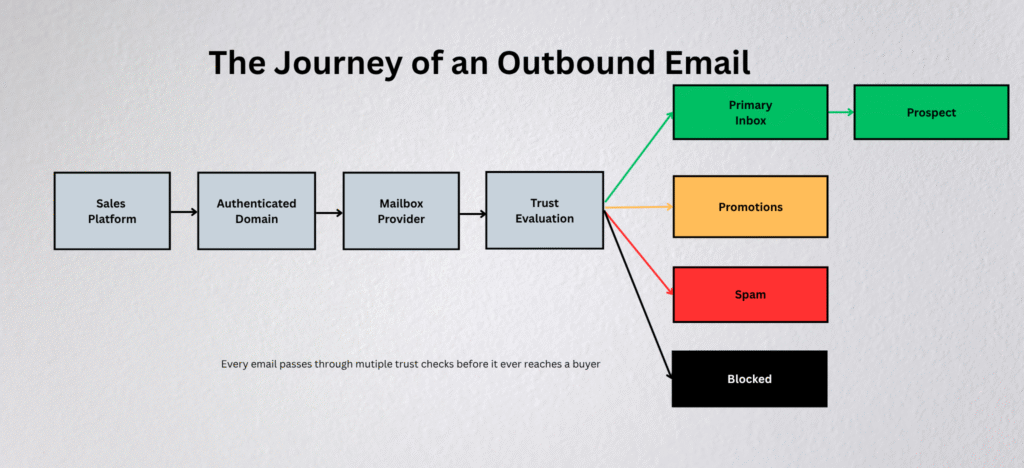
Inbox placement asks the question that actually matters: where did the email land once it got there? Primary inbox, Promotions, Spam, or blocked outright. Only one of those four outcomes reliably produces pipeline.
Deliverability gets the email into the building. Inbox placement decides whether your buyer ever opens the door.
How mailbox providers actually decide. Google, Microsoft, and Yahoo don’t start by reading your sales pitch. They start by asking whether the sender can be trusted — evaluated as a pattern of behavior over time, not campaign by campaign. Think of it like a credit score: one late payment rarely tanks it, but a pattern of missed payments eventually does. Mailbox providers track sending behavior, bounce rates, complaint rates, engagement, authentication status, domain age, and consistency — continuously, in aggregate, well before your message competes for a reader’s attention.
This is now formalized, not just a rule of thumb. Since February 2024, Gmail and Yahoo have required any sender pushing 5,000+ emails a day to personal accounts to authenticate with SPF, DKIM, and a published DMARC record, support one-click unsubscribe, and keep spam complaint rates under a hard 0.3% ceiling — with 0.1% as the actual target for reliable placement. That 0.3% number sounds generous until you do the math: a sender pushing 10,000 emails only needs 30 recipients to hit “report spam” to cross the line.
Enforcement stayed light-touch through most of 2024 and 2025 — mostly warnings and quiet spam-folder placement. That changed on a specific date: starting November 2025, Gmail began actively rejecting non-compliant traffic at the SMTP level, with permanent (550) as well as temporary error codes. Microsoft’s version, rolled out for Outlook, Hotmail, and Live.com addresses in 2025, is even less forgiving — non-compliant bulk mail bounces immediately, with no grace period at all. None of this is optional anymore, regardless of how good your messaging is.
Two details worth knowing if your ICP is mostly B2B: first, the 5,000/day bulk-sender threshold only counts messages sent to personal Gmail and Yahoo accounts — Google Workspace business addresses, where most B2B prospects actually live, don’t count toward it. That doesn’t make authentication optional; poor sending behavior still tanks placement at any volume. Second, Google retired the old Postmaster Tools dashboard (with its High/Medium/Low reputation score) in October 2025 in favor of a binary Compliance Status — you’re either passing the requirements or you’re not. If you haven’t checked Postmaster Tools since that switch, what it’s telling you has changed.
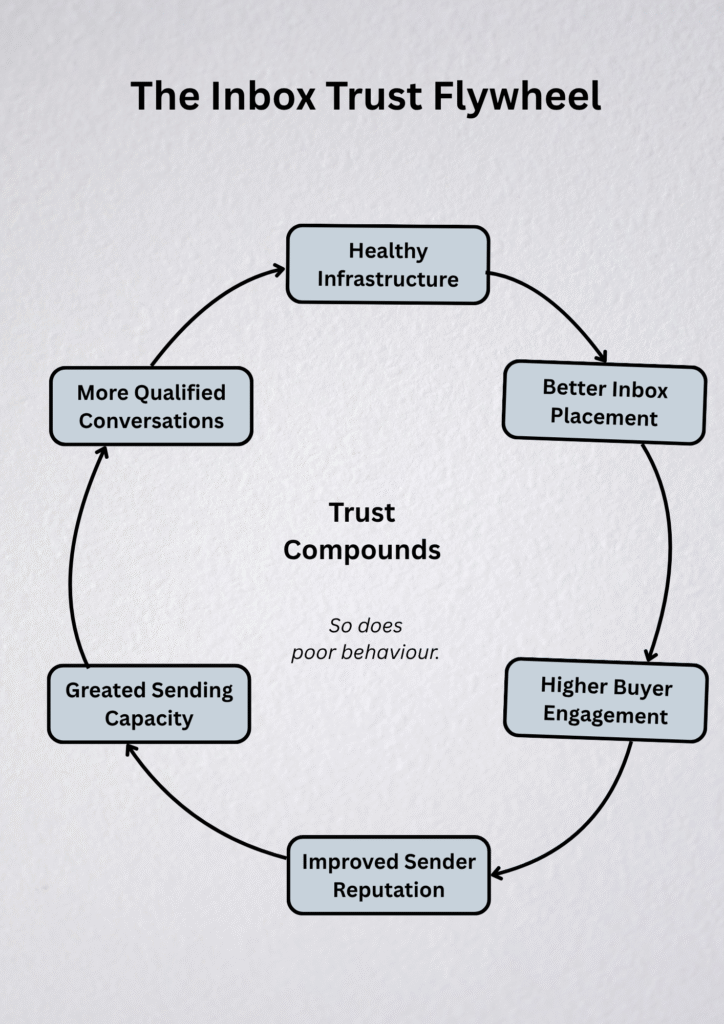
The Inbox Trust Flywheel. The teams that get this right aren’t chasing one good campaign. They’re building a cycle that reinforces itself: healthy infrastructure leads to better inbox placement, which drives higher buyer engagement, which improves sender reputation, which unlocks greater sending capacity, which produces more qualified conversations — which funds the next round of healthy infrastructure. Every well-run campaign strengthens the next one. Every careless one weakens it. Trust compounds in both directions.
How This Plays Out in Real Campaigns
Two cybersecurity startups, same market, opposite outcomes. One launched outbound the same week they bought new domains, sending 300 emails per mailbox on day one with no warmup. The other spent three weeks first: authenticating domains, warming mailboxes gradually, verifying their prospect list, and testing messaging on a small sample before scaling. Within two months, both were sending similar volumes. Only one maintained consistent primary-inbox placement over the following quarter. The difference wasn’t the tooling — both used comparable platforms. It was discipline in the first three weeks.
The agency-side pattern. Teams running outbound at scale consistently report that domains warmed for at least four weeks outperform ones rushed through in seven to ten days, and that capping volume around 30-40 emails per mailbox per day avoids the spam-filter triggers that hit accounts pushing 50-60. This isn’t a minor optimization — it’s frequently the difference between a campaign that compounds and one that quietly poisons its own sending reputation within the first month.
The list-quality trap. A mid-market SaaS company bought a large contact list from a single data provider to hit a volume target quickly. Bounce rates on single-source, unverified lists commonly run 15-25% higher than multi-source, verified data — and every one of those bounces reports back to Gmail and Yahoo as a reputation signal, not a neutral event. Within a month, primary-inbox placement across their entire domain had degraded, affecting campaigns that had nothing to do with the bad list.
Where Deliverability Quietly Breaks
Treating “Delivered” as “Seen.” The easiest mistake to make, and the one hiding inside the founder’s story above: your platform’s “Delivered” status confirms the email reached a mail server. It says nothing about whether a human ever saw it. Always optimize for conversations, not delivery confirmations.
Sending volume from brand-new domains. A domain with no sending history looks suspicious to mailbox providers by default, regardless of message quality. Volume without a warmup period is one of the fastest ways to get flagged.
Ignoring bounce reports until they’re a crisis. Bounces aren’t a neutral technical event — they’re a direct reputation signal to every major mailbox provider. A rising bounce rate is an early warning, not background noise to check later.
Sharing one domain across marketing and cold outreach. Cold outreach carries meaningfully higher complaint risk than opted-in marketing email. Running both from the same domain means a rough cold campaign can damage deliverability for email your customers actually want to receive.
Buying data on volume instead of accuracy. Cheap, unverified lists trade a short-term cost saving for a long-term reputation cost that’s far more expensive to repair than it was to avoid.
Rewriting copy before checking inbox health. This is exactly what cost the founder above two campaign cycles. If reply rates are falling, check deliverability and placement before touching a single word of the email.
The Monthly Inbox Health Checklist
Treat this with the same seriousness as a pipeline review — because in every way that matters to revenue, it is one.
✅ Every sending domain reviewed for reputation trend, not just current status
✅ SPF configured and passing
✅ DKIM configured and passing
✅ A valid DMARC record published and aligned with the From domain
✅ Bounce reports exported and reviewed for spikes
✅ High-risk or flagged inboxes identified and paused if needed
✅ Sending volumes audited against mailbox-level caps (roughly 30-40/day per inbox as a safe ceiling)
✅ Invalid or unverified contacts removed from active lists
✅ Google Postmaster Tools checked for Compliance Status (pass/fail) on every domain
✅ Marketing and cold outreach domains kept separate
The Inbox Health Dashboard: KPIs to Track Monthly
| Metric | Healthy Range | Warning Sign |
| Bounce rate | Below 2-3% | Above 5% |
| Spam complaint rate | Below 0.1% | Approaching or exceeding 0.3% |
| Positive reply rate | Stable or increasing | Declining across multiple campaigns |
| Domain compliance status (Postmaster Tools) | Passing | Failing any requirement |
| Authentication status | Fully configured (SPF, DKIM, DMARC) | Any missing or misaligned record |
| Inbox placement | Mostly Primary | Rising share in Promotions or Spam |
The single most useful habit here: check Google Postmaster Tools before checking your CRM’s open-rate chart. Google overhauled this dashboard in late 2025 — the old High/Medium/Low reputation score is gone, replaced by a binary Compliance Status that simply tells you whether you’re passing or failing the current requirements. It’s a blunter signal than before, but it’s the one mailbox providers actually use to decide your fate. Your reply-rate dashboard doesn’t.
Founder Insight
The mistake I see founders make over and over isn’t a lack of effort — it’s misdiagnosis. They see a reply-rate problem and reach for a copywriting fix, because copy is the thing they can control and see immediately. Deliverability is invisible until you go looking for it, which is exactly why it’s the first place to check, not the last. I’ve watched teams rewrite a campaign three times chasing a problem that a five-minute domain audit would have caught on day one.
Consultant Tip
Never wait for performance to decline before checking domain health — by the time reply rates drop, the reputation damage is usually already weeks old, and recovery takes far longer than prevention would have. At FunnlQ, we run this as a standing monthly review: domain reputation, authentication status, bounce trends, reply quality, sending behavior, and list quality, reviewed together, every month, whether or not a campaign is underperforming. Treat it exactly like a pipeline review — not something you only open when the numbers look bad.
Summary
Modern outbound isn’t primarily a writing problem anymore. It’s a trust problem, decided by mailbox providers before your prospect ever gets the chance to judge your message on its merits. Inbox Engineering is the discipline of building and protecting that trust deliberately — authenticated domains, disciplined warmup, clean data, and a monthly review process that catches reputation drift before it shows up as a revenue problem.
The companies that treat deliverability as a strategic function generate meaningfully more conversations without sending a single additional email. That’s the entire point: better inbox placement doesn’t require more volume. It requires more discipline.
Inbox health isn’t an IT metric. It’s a revenue metric, and it deserves the same monthly attention as your pipeline.
Frequently Asked Questions
Does Gmail automatically block cold email? No. Gmail evaluates trust signals — authentication, sending behavior, complaint rates, and recipient engagement. Cold email itself isn’t automatically blocked, but sending it without proper authentication and warmup makes spam filtering far more likely.
Is domain warmup still necessary in 2026? Yes. Gradual, consistent sending volume builds a healthier reputation than sudden spikes, and mailbox providers evaluate sending patterns over time rather than judging a single send in isolation.
Can strong copywriting overcome poor deliverability? Rarely. Even excellent messaging can’t generate replies if the email consistently lands in spam or a secondary tab where it’s never seen.
Should marketing emails and cold outreach share the same domain? Best practice is to separate them. Cold outreach carries a higher complaint risk than opted-in marketing email, and keeping them on the same domain means a rough outbound campaign can damage deliverability for email your existing customers actually want.
What spam complaint rate should I be targeting? Gmail and Yahoo enforce a hard ceiling of 0.3%, but the real target for reliable inbox placement is under 0.1%. At 10,000 emails sent, that’s the difference between roughly 10 complaints and 30.
Ready to Fix the Layer Underneath Your Outbound?
At FunnlQ, Inbox Engineering is built into every outbound program we run — because messaging and targeting can’t do their job if the email never reaches a primary inbox.
We help SaaS founders and sales leaders:
- Audit domain authentication (SPF, DKIM, DMARC) and fix gaps before they cost pipeline
- Set up warmup schedules and sending caps that protect long-term reputation
- Monitor bounce rates, complaint rates, and inbox placement monthly, not reactively
- Separate marketing and outbound sending infrastructure the right way
- Diagnose whether a reply-rate problem is actually a deliverability problem before touching the copy
If your outbound numbers look off and you’ve already rewritten the campaign twice, the fix might not be in the copy at all. Connect with FunnlQ and get your inbox health audited before you write another subject line.