-
FunnlQ
- October 13, 2026
Replacing SDRs With AI Is Backfiring: Here’s the Role Redesign That Actually Works
Gartner surveyed 645 B2B buyers this year and found something that sounds like a contradiction until you sit with it for a minute: 67% of buyers say they’d prefer a sales-rep-free experience, and 70% prefer a fully digital, self-service buying journey. Read only that far, and the conclusion looks obvious — buyers don’t want to talk to reps anymore, so replace the reps with AI and let buyers self-serve.
The same research found the opposite is also true. Buyers still rely on human reps at specific, critical moments — to confirm AI-generated insights are actually trustworthy, to reduce uncertainty before a purchase, to help build internal support across a buying committee, and to strengthen their own confidence before signing. Both findings came from the same survey, the same buyers, describing the same journey. They’re not contradicting each other. They’re describing two different jobs that used to be bundled into one role, and Gartner’s actual conclusion — not “replace sellers with AI,” but “redesign the role around where humans add irreplaceable value” — is the one most companies have quietly skipped past on their way to buying an AI SDR platform.
This is the piece that closes out our series on AI in outbound. Our earlier pieces covered where AI genuinely outperforms humans, and why so many AI SDR deployments end up cancelled within a year. This one answers the question underneath both of those: not “AI or human,” but what the SDR role actually needs to become now that buyers research differently than they did five years ago.
Why It Matters
The scale of this shift is no longer a prediction — it’s already happened faster than most sales organizations have adjusted for. Gartner’s 2025 Sales Technology Report found 89% of revenue organizations already using AI somewhere in their sales process, up from just 34% in 2023 — three years, a 55-point jump. Gartner projects that by 2027, 95% of sellers’ own research workflows will begin with AI, up from under 20% in 2024.
Here’s the finding that should reframe how every sales leader thinks about this, rather than just accepting it as background noise: Gartner’s research found that sales organizations providing AI-enabled next-best-action guidance to their sellers are 2.6 times more likely to achieve commercial growth than organizations without it. That statistic isn’t about replacing sellers with AI. It’s about sellers working alongside AI that tells them where to focus — which is a meaningfully different tool than an AI SDR platform trying to run the whole motion on its own.
As Gartner analyst Greg Hessong put it plainly: “The most effective sales organizations are not simply layering AI onto existing ways of working… they are redesigning seller workflows so AI can support execution, recommendations, and orchestration, while sellers focus their time on the moments where human judgment and customer value matter most.” That’s the actual mandate, and it’s a redesign question, not a headcount question.
The Framework: Three Buckets, Not One Job
The traditional SDR role was never really one job. It was several different jobs bundled into a single seat: researcher, copywriter, data-entry clerk, qualification screener, follow-up machine, objection handler, meeting scheduler, and market feedback loop, all performed by one person, usually junior, usually early in their sales career. AI didn’t break that role. It made the bundle visible, by proving that some of those tasks could be automated cleanly while others clearly couldn’t.
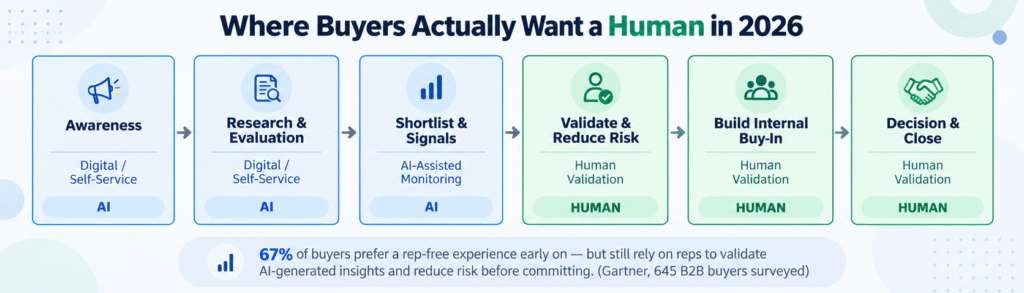
Automate — AI owns fully. Prospect research, list building, data enrichment, CRM updates, first-touch drafts, and routine follow-up sequencing all share the same underlying characteristics: a clear input, a clear policy for how to act on it, a measurable output, and a known escalation path if something looks wrong. Tasks that meet all four conditions are strong candidates for full automation, and pretending otherwise mostly just wastes a skilled person’s time on work a system can do as well or better.
Assist — AI drafts, human approves. Lead scoring, personalization at scale, meeting scheduling logistics, and signal-based next-best-action recommendations benefit from AI doing the heavy lifting while a human makes the final call. This is precisely the category the 2.6x growth statistic above is describing — AI providing the recommendation, a human providing the judgment about whether to act on it.
Keep human — human owns fully. Objection handling, discovery conversations, validation and risk reduction, building internal buy-in across a buying committee, negotiation, and strategic account work all depend on exactly the qualities Gartner’s research says buyers still need a human for: judgment, empathy, and the ability to reduce a buyer’s uncertainty in a way a script or an algorithm can’t yet replicate convincingly.
The mistake most companies make isn’t picking the wrong bucket for a given task. It’s never doing the sorting exercise at all — either keeping every task fully human, or handing every task to AI, instead of doing the deliberate, task-by-task redesign this framework requires.
Where Buyers Actually Want a Human
Mapping the three-bucket framework onto the actual buyer journey makes the redesign concrete rather than theoretical.
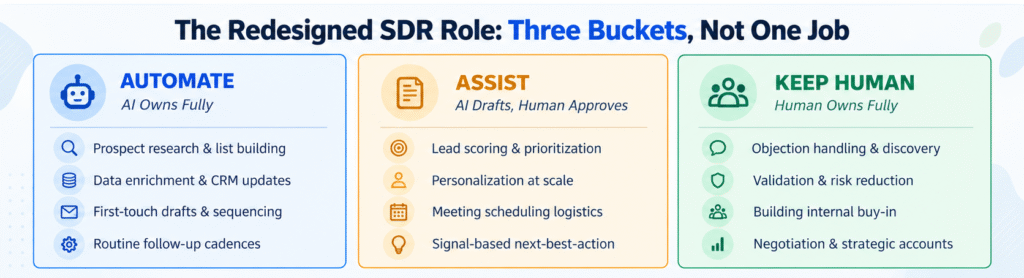
Early in the journey — awareness, initial research, evaluating a shortlist — buyers overwhelmingly prefer to self-serve, consistent with the 67-70% preference data above. This is where AI-driven content, signal monitoring, and automated first-touch outreach genuinely meet buyers where they already want to be, rather than interrupting a process they’d rather run themselves.
The shift happens at a specific, identifiable point: the moment a buyer needs to validate what they’ve learned, reduce the risk of being wrong, or build a case internally to convince other stakeholders. That’s precisely where Gartner’s data shows human reps remain essential — not because buyers enjoy sales calls, but because a real person can absorb context, respond to an unscripted concern, and lend credibility an AI-generated recommendation doesn’t yet carry on its own for a decision this consequential.
As Gartner analyst Blaisdell frames it: “Sales leaders should not interpret buyer preference for digital self-service as a signal that sellers matter less. It is a signal that sellers need to show up differently, engaging where they can help buyers validate information, reduce risk, and move forward with greater confidence.” That’s the redesign in a single sentence: less time on tasks buyers would rather handle themselves, more concentrated time exactly where a human is still irreplaceable.
Where This Redesign Goes Wrong
Layering AI onto the old job description instead of rebuilding it. Buying an AI SDR platform and asking it to do everything the human SDR used to do, just faster, isn’t a redesign — it’s automation applied to a role that was never built with automation in mind. Hessong’s own warning is direct: “Sales leaders who win with AI will not ask sellers to do everything they did before, just faster.”
Reading buyer self-service preference as “sellers don’t matter.” This is the exact misreading Gartner’s research explicitly warns against. The 67% who prefer a rep-free early experience aren’t rejecting human sellers — they’re rejecting unnecessary human involvement in the parts of the journey they can handle themselves, which is a very different, much more specific finding.
Removing humans from the validation moments, not just the research moments. Some companies, chasing efficiency, end up automating the exact stages where buyers most need human reassurance — objection handling, risk reduction, internal buy-in — because those stages are harder to automate well, not because buyers want them automated. This is close to precisely backwards from what the data supports.
Not reinvesting the time AI actually saves. Automating the research, drafting, and follow-up tasks frees up meaningful time. Companies that don’t deliberately redirect that freed time toward deeper discovery, better-prepared validation conversations, and stronger internal-champion support are capturing the cost savings of AI without capturing the growth Gartner’s 2.6x figure describes.
Treating this as a one-time reorganization instead of an ongoing recalibration. Which tasks belong in which bucket will keep shifting as AI capability improves. A redesign done once, in a single planning cycle, and never revisited will drift out of date the same way an ICP or a tech stack does if nobody owns updating it.
The SDR Role Redesign Checklist
- Every current SDR task has been sorted into automate, assist, or keep-human — not assumed to be entirely one or the other
- Automated tasks meet all four conditions: clear input, clear policy, measurable output, known escalation path
- Time freed up by automation has an explicit plan for reinvestment, not just a headcount reduction
- Human involvement is concentrated at buyer validation and risk-reduction moments, not spread thin across the entire journey
- AI-enabled next-best-action guidance is available to human reps, not just automation running independently of them
- The bucket assignments are scheduled for review at least twice a year, not set once and left alone
KPIs to Track
- Time reinvested in discovery and validation conversations per rep, before and after the redesign, to confirm freed-up time is actually being redirected rather than lost
- Meeting-to-opportunity conversion at human-owned stages, tracked separately from AI-assisted stages, to confirm the redesign is actually improving where it’s supposed to
- Buyer-reported confidence or satisfaction at the validation stage, gathered through post-meeting or post-deal feedback, since this is the moment Gartner’s research identifies as most dependent on human quality
- Ratio of AI-enabled next-best-action adoption among reps, since the 2.6x growth finding depends on reps actually using the guidance, not just having access to it
- Task bucket drift, reviewed periodically — how many tasks have moved between automate, assist, and keep-human since the last review, as a signal of how fast the underlying capability is changing
Founder Insight
The founders getting this right aren’t the ones with the most sophisticated AI stack. They’re the ones who actually sat down and asked, task by task, which parts of the old SDR job a person should still be doing — instead of assuming the answer was either “all of it” or “none of it.” The buyer data makes the answer pretty clear if you’re willing to look at it stage by stage instead of trying to make one blanket decision about the whole role.
Consultant Tip
When a client asks whether they should replace their SDR team with AI, I ask them to list every task their SDRs actually do in a week, then sort each one into automate, assist, or keep-human before we talk about tools at all. Almost nobody has done this exercise before. It usually takes an hour, and it consistently produces a clearer, more defensible plan than any vendor demo does — because it starts from your buyer’s actual journey, not a platform’s feature list.
Summary
The debate over whether AI is replacing SDRs has mostly been asking the wrong question. Gartner’s own research, drawn from hundreds of chief sales officers and hundreds of B2B buyers, points to a more precise answer: buyers want less human involvement in the parts of the journey they can handle themselves, and more concentrated, higher-quality human involvement at the specific moments where they need validation, risk reduction, and confidence before committing.
That’s not a headcount story. It’s a redesign story — sorting the old, overloaded SDR role into what AI should own, what AI should assist with, and what still genuinely needs a human, and then making sure the time AI frees up gets reinvested into the moments that actually move a deal forward. Companies that do this redesign deliberately are seeing real, measured growth from it. Companies that just point an AI SDR platform at the old job description and hope for the same result are the ones showing up in the cancellation data covered elsewhere in this series.
Frequently Asked Questions
Is AI actually replacing the SDR role in 2026? Partially, and unevenly. Gartner’s research shows 89% of revenue organizations already using AI in sales, but the data points toward redesigning the role rather than full replacement — buyers still want human involvement at specific validation moments, even as they increasingly self-serve earlier in the journey.
Why do buyers say they want a rep-free experience but still rely on reps? Because these describe two different parts of the journey. Buyers prefer to self-serve during research and early evaluation, but still want human validation, risk reduction, and confidence-building before making a final decision — a nuance that gets lost when the finding is summarized as a single statistic.
What SDR tasks should be automated first? Tasks with a clear input, a clear policy for action, a measurable output, and a known escalation path — typically prospect research, list building, data enrichment, CRM updates, and first-touch drafting. Tasks lacking those four conditions are poor candidates for full automation.
What should never be automated in the SDR role? Objection handling, discovery conversations, validation and risk-reduction conversations, building internal buyer buy-in, and negotiation. Gartner’s buyer research consistently identifies these as the moments where human judgment and empathy remain essential.
How often should a company revisit its AI/human task redesign? At least twice a year. AI capability is shifting quickly enough that a redesign done once and never revisited will drift out of date, similar to how an ICP or a tech stack needs periodic reassessment rather than a one-time setup.
Ready to Redesign Your Outbound Around How Buyers Actually Buy?
At FunnlQ, we help SaaS founders and revenue leaders redesign their outbound motion around real buyer behavior, not around whichever AI SDR platform had the best demo.
We help teams:
- Sort SDR tasks into automate, assist, and keep-human, based on your actual buyer journey
- Identify where your buyers need human validation most, and concentrate rep time there
- Set up AI-enabled next-best-action guidance that supports reps instead of replacing their judgment
- Build a reinvestment plan for the time AI actually frees up, not just a cost-cutting plan
- Review and recalibrate the redesign on a regular cadence as AI capability shifts
If you’re deciding whether to buy an AI SDR platform, the task-by-task redesign exercise is worth doing before the demo, not after the contract. Connect with FunnlQ and let’s map your buyer journey before you map your tech stack.