-
FunnlQ
- August 31, 2026
The pitch deck never mentions what happens six months in. The renewal conversation always does.
We spoke with a founder recently who was quietly re-buying aged domains on the secondary market. Not for a new product launch — to restart the same outbound program he’d shut down eight months earlier. His original domains had been burned by an AI SDR platform that sent volume nobody had capped, on data nobody had cleaned, until Gmail and Outlook stopped delivering the mail at all. Rebuilding that reputation from scratch, he’d learned, takes longer than it took to destroy it.
That story doesn’t show up on any AI SDR vendor’s dashboard. It shows up eight or nine months later, as a deliverability rebuild, a domain reputation recovery, and a sales cycle that’s quietly lost a full quarter of runway. It’s also a smaller version of the same pattern playing out across the industry at scale: somewhere between 50% and 70% of AI SDR tools get cancelled within their first year — roughly double the turnover rate of the human reps many of these tools were bought to replace.
That’s not a rounding error or a footnote. That’s more than half a category failing to survive its own first renewal. In our companion piece comparing AI and human SDR performance, we covered the data on where AI genuinely helps and where humans still win. This piece goes one layer deeper: if the technology itself works — and the evidence says it largely does — why do so many deployments still end up cancelled, and what’s actually happening in the months between the enthusiastic launch and the quiet cancellation?
Why It Matters
Gartner’s own research puts a number on how systemic this is: the firm expects companies to cancel more than 40% of agentic AI projects industry-wide by the end of 2027. AI SDRs sit squarely inside that broader pattern, not off to the side of it. At the same time, adoption isn’t slowing down — Salesforce’s 2026 State of Sales research found more than half of sellers had already used an AI agent in their workflow. Both of those facts are true simultaneously, and that’s exactly the detail that should give any buyer pause: rising adoption and rising failure rates aren’t a contradiction. They’re the same story, told from two different angles. Most of what’s actually breaking underneath these deployments is a data and process problem wearing an AI costume.
The stakes are higher than a wasted subscription fee. A poorly deployed AI SDR doesn’t just fail quietly and get cancelled — it can actively damage the sending infrastructure and domain reputation an outbound program depends on for years afterward, exactly as it did for the founder rebuilding his domains from scratch. Understanding why these deployments fail isn’t just about avoiding a bad tool purchase. It’s about avoiding a mistake that can cost far more than the contract itself to undo.
The Framework: The Four Root Causes
Pulling from field data across multiple 2026 industry analyses, the same four failure points show up again and again, across companies with otherwise very different products, sizes, and markets.
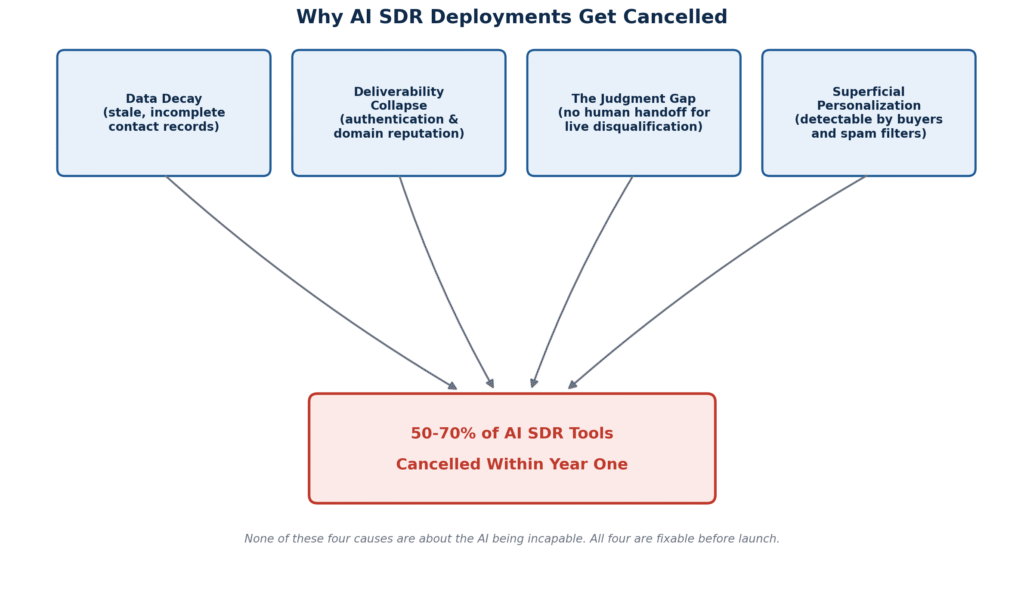
Data decay. According to research cited by Eubrics, 60% of sales leaders identify poor data quality as their single biggest AI adoption challenge — the top-ranked obstacle, ahead of cost, ahead of change management, ahead of everything else. B2B contact data is notoriously scattered across multiple systems and decays continuously as people change roles and companies. An AI SDR doesn’t pause to notice a contact record looks stale the way a human rep sometimes instinctively does. It executes faithfully against whatever it’s given, which means decayed data doesn’t just waste send capacity — it actively damages sender reputation through rising bounces and spam complaints, at a volume no human team would generate manually.
Deliverability collapse. This is the failure mode that turns a disappointing tool into a genuinely expensive mistake, and it’s rarely on anyone’s radar until it’s already happened. Between November 2025 and May 2026, the rules governing inbox access tightened sharply: Gmail moved from soft-throttling non-compliant bulk mail to issuing permanent rejections outright, and Microsoft began enforcing comparable authentication standards for Outlook and Hotmail addresses. An AI SDR running high volume through under-authenticated infrastructure doesn’t get a warning. It simply stops arriving — and by the time anyone notices reply rates have collapsed, the domain reputation behind it can take months to rebuild, not days.
The judgment gap. An AI system can qualify a prospect competently against firmographic filters. It’s considerably less reliable at disqualifying one in the middle of a live conversation — the moment a prospect says something like “we actually just brought that in-house last month,” and a human rep instinctively ends the call cleanly rather than pushing forward on a dead lead. That judgment gap is where a large share of the meetings-booked-but-never-convert pattern actually originates. AI SDRs have made booking meetings roughly ten times easier than it used to be. They haven’t made it appreciably easier to turn those meetings into closed revenue, and that gap is exactly where most deployments start to wobble.
Superficial personalization. Buyers have gotten sharp at spotting AI-written outreach at a glance, and mailbox providers are increasingly using similar signals to filter it. Personalization that amounts to swapping in a first name and a company name, without genuine relevance underneath it, is detectable both by the human reading it and, increasingly, by the spam filter deciding whether they ever see it at all.
The AI SDR Cancellation Timeline
None of these four failure modes typically cause an immediate, obvious collapse. They show up as a slow drift, which is exactly what makes them so easy to miss until the pattern is already well established.
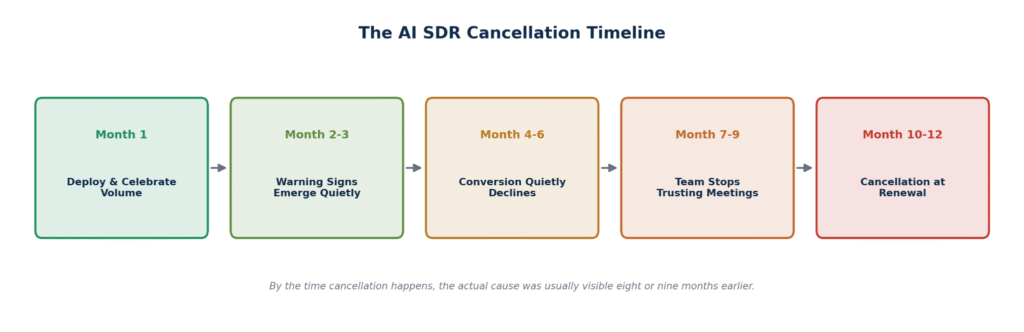
Month 1: Deploy and celebrate volume. Outbound activity jumps immediately and dramatically — this is genuinely real, not an illusion. The dashboard looks better than it ever has. Nobody’s looking for problems yet, because there’s no reason to.
Months 2-3: Warning signs emerge quietly. Reply rates, measured as a percentage rather than a raw count, start to soften. A few mailboxes show unusual bounce patterns. Nothing alarming enough yet to interrupt the enthusiasm from month one, and nobody’s built a habit of checking these specific numbers yet.
Months 4-6: Conversion quietly declines. Meetings are still getting booked, sometimes at an impressive rate. But the sales team starts privately describing a growing share of them as “not really qualified” — a phrase that doesn’t appear on any dashboard, but that reliably predicts what the opportunity data will confirm a few weeks later.
Months 7-9: The team stops trusting the meetings. AEs start quietly deprioritizing AI-sourced meetings on their calendar, or preparing less for them, because experience has taught them the hit rate is lower. This is the point where the tool’s problems stop being a data question and start being a trust question — and trust, once it erodes internally, is much harder to rebuild than a bounce rate.
Months 10-12: Cancellation at renewal. By the time the actual cancellation decision gets made, it rarely comes as a surprise to anyone who was paying attention. The real cause was usually visible eight or nine months earlier, in the metrics nobody was tracking yet.
Where the Wheels Come Off
Treating the launch like a light switch instead of a rollout. Automation scales whatever’s already underneath it — a broken playbook, a stale contact list, an undefined handoff process — at machine speed, instead of fixing any of it first. Flipping an AI SDR on against an unaudited process doesn’t fix that process. It just breaks it faster and at a much larger scale.
Measuring success in month one, not month four. Every one of the four root causes above takes time to become visible in the numbers a typical dashboard shows first. A team that declares victory based on 30-day volume is looking at exactly the metric least likely to reveal any of these problems.
No re-verification of authentication before scaling volume. As covered in our companion piece on domain authentication, SPF, DKIM, and DMARC don’t stay correctly configured automatically just because a new sending tool is technically working. An AI SDR pushing volume through infrastructure that was never re-verified for the new tool is the single fastest path to the deliverability collapse described above.
No human checkpoint for disqualification. Leaving qualification entirely to the AI, with no human reviewing a sample of conversations or handling live disqualification, means the judgment gap has no safety net. The AI keeps booking meetings it shouldn’t, and nobody catches it until the AE calendar is full of dead-end calls.
Believing the vendor’s volume numbers are the whole story. Vendors show the numbers that look best earliest, for entirely understandable reasons. Buyers who don’t independently ask for meeting-to-opportunity conversion data, not just meetings booked, are evaluating the deployment on exactly the metric least correlated with long-term success.
The Pre-Cancellation Warning Signs Checklist
If more than two or three of these are true at your current AI SDR deployment, you’re likely already on the timeline above, whether or not anyone’s said so out loud yet.
- Reply rate as a percentage has declined since launch, even if raw reply count has risen
- Nobody has re-verified SPF, DKIM, and DMARC specifically for this tool since it went live
- CRM data hasn’t been audited or cleaned in the months since deployment
- AEs have started informally commenting that AI-sourced meetings feel lower quality
- Meeting-to-opportunity conversion isn’t being tracked separately from human-sourced meetings
- Nobody is reviewing a sample of AI-generated outreach on a regular cadence
- The tool was deployed against a broad target list rather than a narrow, validated ICP
- There’s no defined human handoff point for objection handling or live disqualification
KPIs to Track From Day One
- Meeting-to-opportunity conversion rate, tracked separately for AI-sourced and human-sourced meetings, from the very first meeting booked
- Reply rate as a percentage of volume, not just raw reply count, reviewed weekly rather than monthly
- Bounce and spam complaint rate, checked against the same 0.3% hard ceiling and 0.1% target covered in our deliverability series
- Domain compliance status in Google Postmaster Tools, reviewed alongside the AI SDR’s own dashboard, not instead of it
- AE sentiment on meeting quality, gathered informally but consistently — it tends to predict the hard numbers by four to six weeks
Founder Insight
The founders I’ve watched avoid this pattern weren’t the ones with the most sophisticated AI SDR setup. They were the ones who treated month one as the beginning of an evaluation, not the end of one. Every failure mode in this piece takes a quarter or more to become undeniable in the data. If you’re only looking at the numbers that are available in week one, you’re structurally unable to see the problem coming — by design, not by bad luck.
Consultant Tip
Before you sign an annual contract, ask the vendor directly what percentage of their customers renew after year one, and ask for the meeting-to-opportunity conversion rate from a customer with a deal complexity similar to yours — not a general case study. A vendor confident in their retention numbers will usually share them without much hesitation. One that deflects the question is telling you something worth hearing before you sign, not after.
Summary
The AI SDR failure pattern isn’t really a story about the technology not working. Across the field data, the tools themselves largely do what they claim: they generate volume and personalization at a scale no human team can match. The failure pattern is a story about deployment — data that was never cleaned, infrastructure that was never re-verified, judgment calls that were never handed to a human, and personalization that never went beneath the surface. All four of those causes are fixable before launch. None of them get fixed by a better version of the same tool, deployed the same way.
The founder buying aged domains to restart his outbound program didn’t have a bad AI SDR. He had an AI SDR deployed without the groundwork that would have made it work — and by the time that became obvious, the cost had already gone well past the subscription fee.
Frequently Asked Questions
Why do so many AI SDR tools get cancelled within the first year? Field data points to four recurring causes: data decay from unaudited CRM records, deliverability collapse from under-authenticated sending infrastructure, a judgment gap in objection handling and live disqualification, and superficial personalization that both buyers and spam filters increasingly detect. None of these are primarily about the AI’s underlying capability.
How long does it take for an AI SDR deployment problem to become visible? Typically a full quarter or more. Volume and meetings-booked numbers look strong almost immediately; meeting-to-opportunity conversion, the metric that actually predicts long-term success, usually takes three to six months to reveal a problem clearly.
Can a bad AI SDR deployment damage more than just the tool’s own results? Yes. Poorly managed sending volume through under-authenticated infrastructure can damage domain reputation broadly, affecting deliverability for other outbound efforts and sometimes requiring a full domain rebuild that takes months to recover from.
What’s the single best early warning sign that an AI SDR deployment is heading toward cancellation? A sales team informally describing AI-sourced meetings as lower quality, even before the hard conversion numbers confirm it. This sentiment consistently predicts the metrics by four to six weeks in the patterns we’ve seen.
Is the solution to avoid AI SDRs entirely? No — the data in our companion piece shows hybrid deployments, combining AI with human judgment at the right points, meaningfully outperforming both AI-only and human-only teams. The solution is deploying deliberately, with clean data, verified infrastructure, and a defined human handoff, rather than avoiding the technology altogether.
Ready to Deploy AI Without Joining the 50-70%?
At FunnlQ, we help SaaS founders and revenue leaders build the groundwork an AI SDR deployment actually needs to survive past its first renewal.
We help teams:
- Audit CRM data and ICP definition before any AI SDR platform goes live
- Verify SPF, DKIM, and DMARC specifically for new sending tools before volume scales
- Design a clear human handoff for objection handling and live disqualification
- Set up meeting-to-opportunity tracking from day one, not after a problem is already visible
- Evaluate AI SDR vendors against real conversion and retention data, not demo-day volume numbers
If you’re already running an AI SDR and something feels off but you can’t quite point to why, the four causes in this piece are the right place to start looking. Connect with FunnlQ and get ahead of the renewal conversation before it becomes a cancellation.